
The Cultural and Historical Evolution of Kotagede: A Comprehensive Analysis of the Mataram Legacy and the Silver Craft Industry of Yogyakarta
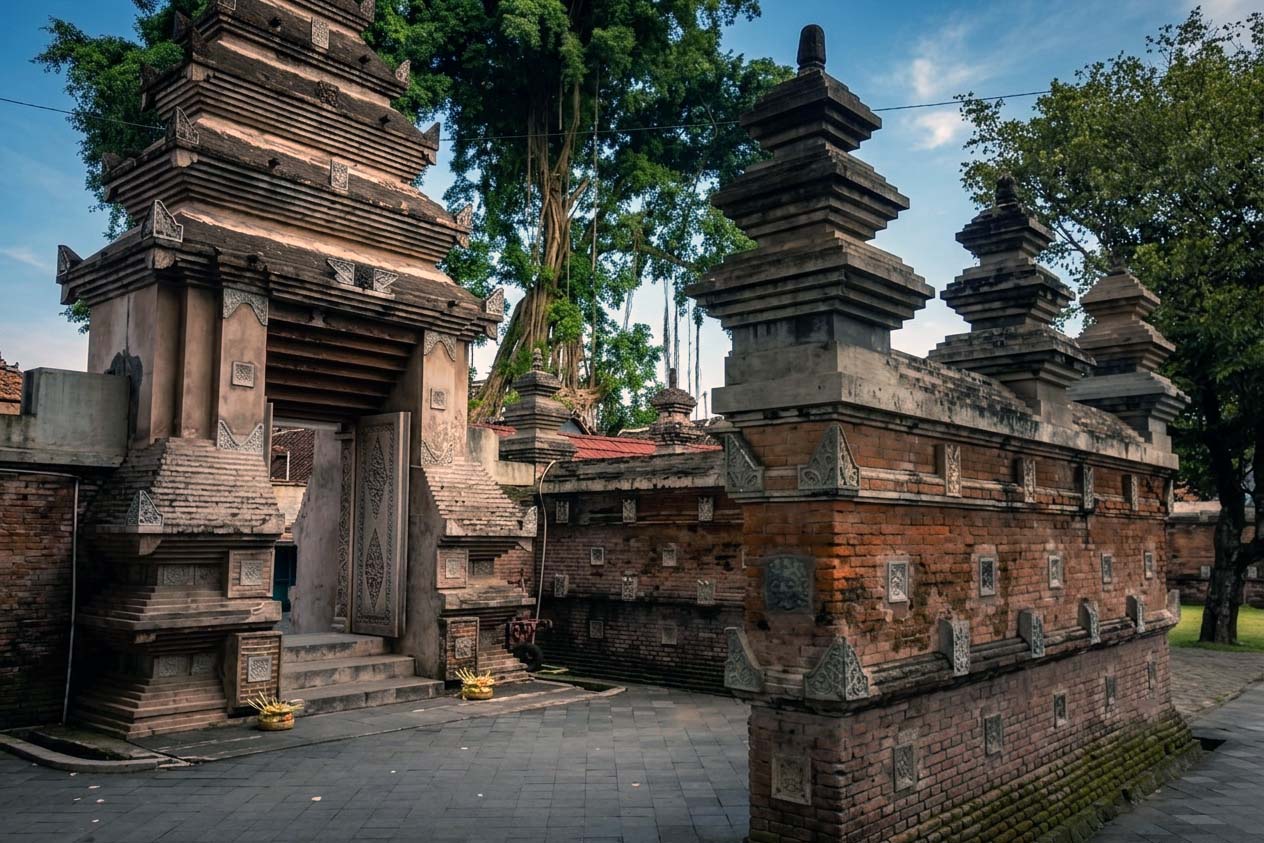
The district of Kotagede, situated in the southeastern periphery of Yogyakarta, represents a profound urban palimpsest where the foundational elements of the Islamic Mataram Sultanate intersect with centuries of artisanal evolution and spiritual continuity. Established in the late sixteenth century within the dense forest of Alas Mentaok, Kotagede transitioned from a reward for military loyalty into the sovereign heart of a kingdom that would eventually dominate the Javanese landmass.1 Today, it functions as a “living museum,” a designation that reflects the survival of sixteenth-century urban planning, eighteenth-century aristocratic architecture, and twentieth-century mercantile opulence, all coexisting within a modern administrative subdistrict.3 This report examines the multi-layered significance of Kotagede, analyzing its historical genesis, its unique architectural vernacular, the socio-economic dynamics of its silver industry, and its enduring role as a spiritual nexus for the Javanese people.
The Historical Genesis of the Mataram Sultanate at Kotagede
The emergence of Kotagede as a center of power was the result of a strategic territorial grant during the decline of the Pajang Kingdom. In 1549, Sultan Hadiwijaya of Pajang rewarded his retainer, Ki Ageng Pamanahan, with the forest of Alas Mentaok for his role in suppressing the rebellion led by Arya Penangsang.1 This grant was more than a mere agricultural endowment; it was the planting of a dynastic seed. Pamanahan, along with his son Danang Sutawijaya and the advisor Ki Juru Martani, cleared the forest to establish a settlement that balanced strategic defensive positioning near the Gajah Wong River with fertile agricultural potential.1
The Reign of Panembahan Senopati and Sovereignty
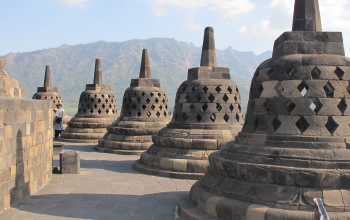
Upon the death of Ki Ageng Pamanahan in 1575, Danang Sutawijaya assumed leadership and gradually distanced the settlement from Pajang’s authority. Adopting the title Panembahan Senopati Ingalaga, he declared independence and established the Mataram Sultanate, positioning Kotagede as its first capital.1 Senopati’s reign was characterized by the consolidation of power across Central and East Java, a feat achieved through a combination of military prowess and spiritual legitimization. His legacy is particularly notable for the claim of direct descent from the ancient Mataram kings who constructed the Borobudur and Prambanan temple complexes, effectively bridging the gap between Java’s Hindu-Buddhist past and its Islamic future.6
| Historical Figure | Role in Kotagede’s Formation | Key Contributions |
| Ki Ageng Pamanahan | Patriarchal Founder | Cleared Alas Mentaok; established the first Mataram settlement.1 |
| Panembahan Senopati | First Sovereign King | Declared independence; founded the state mosque and royal cemetery.1 |
| Ki Juru Martani | Chief Advisor (Patih) | Orchestrated the political and spiritual statecraft of the early Sultanate.5 |
| Sultan Agung | Third King of Mataram | Expanded the empire to its zenith; institutionalized the Javanese-Islamic calendar.2 |
The eventual relocation of the capital—first to Kerta under Sultan Agung, and later to Plered, Kartasura, and finally the current seats in Yogyakarta and Surakarta—did not diminish Kotagede’s status. Instead, the area evolved into a sacred ancestral hub, a “Mother City” that remained the site of royal interment and spiritual pilgrimage long after the administrative functions of the state had moved elsewhere.1
Urban Morphology: The Catur Gatra Tunggal Philosophy
The physical layout of Kotagede was dictated by the Catur Gatra Tunggal (Four Components in One) philosophy, a conceptual framework for Javanese-Islamic urban design that ensured a harmonious balance between the political, spiritual, economic, and social spheres of life.4 This model remains the foundational blueprint for urban centers throughout Central Java.
Integration of the Four Elements
The spatial arrangement in Kotagede placed the central power at the heart of the community, surrounded by supporting institutions:
- The Keraton (Palace): Representing the apex of political and administrative authority. While the original wooden structures have eroded or been destroyed, the location remains etched into the district’s geography through toponyms and archaeological remains.3
- The Masjid Gedhe (Great Mosque): Positioned to the west of the central square, it symbolized the spiritual legitimacy of the ruler and provided a center for religious education and community worship.1
- The Pasar (Market): Located to the north or east, the market served as the economic nucleus, facilitating trade and social interaction between the palace and the commoners.4
- The Alun-Alun (Square): A public common area used for military training, royal addresses, and community festivities, acting as a transitional space between the various sectors of the city.4
This urban structure created a dense, navigable city characterized by narrow alleys and high-walled residential compounds (kampungs). These kampungs were often organized by craft or social role, such as Pandheyan for blacksmiths or Sayangan for coppersmiths, a nomenclature that persists in the modern street map of Kotagede.3
Kotagede Architectural Vernacular: From Joglo to Kalang Eclecticism
The architectural history of Kotagede is a visual record of Java’s social hierarchy and its changing economic fortunes. The district contains a high density of traditional joglo houses, alongside the unique and opulent Rumah Kalang (Kalang Houses), which reflect a period of intense globalization in the late 19th century.3
The Symbolic Structure of the Joglo
The joglo is the traditional dwelling of the Javanese aristocracy and is characterized by its complex wooden joinery and symbolic verticality. The structure is built around the saka guru, four central pillars that support the highest point of the roof, representing the stability of the cosmic order.5
- Tumpangsari: These are layered wooden beams stacked above the saka guru, often elaborately carved to demonstrate the owner’s status.5
- Senthong Tengah: The innermost sacred room, typically reserved for meditation or offerings to Dewi Sri, the goddess of fertility and rice.5
- Technique: Authentic joglo construction utilizes the purus and pasak system, a method of interlocking wood without metal nails, which allows the structure to flex during seismic events.8
The Kalang Houses: A Mercantile Renaissance
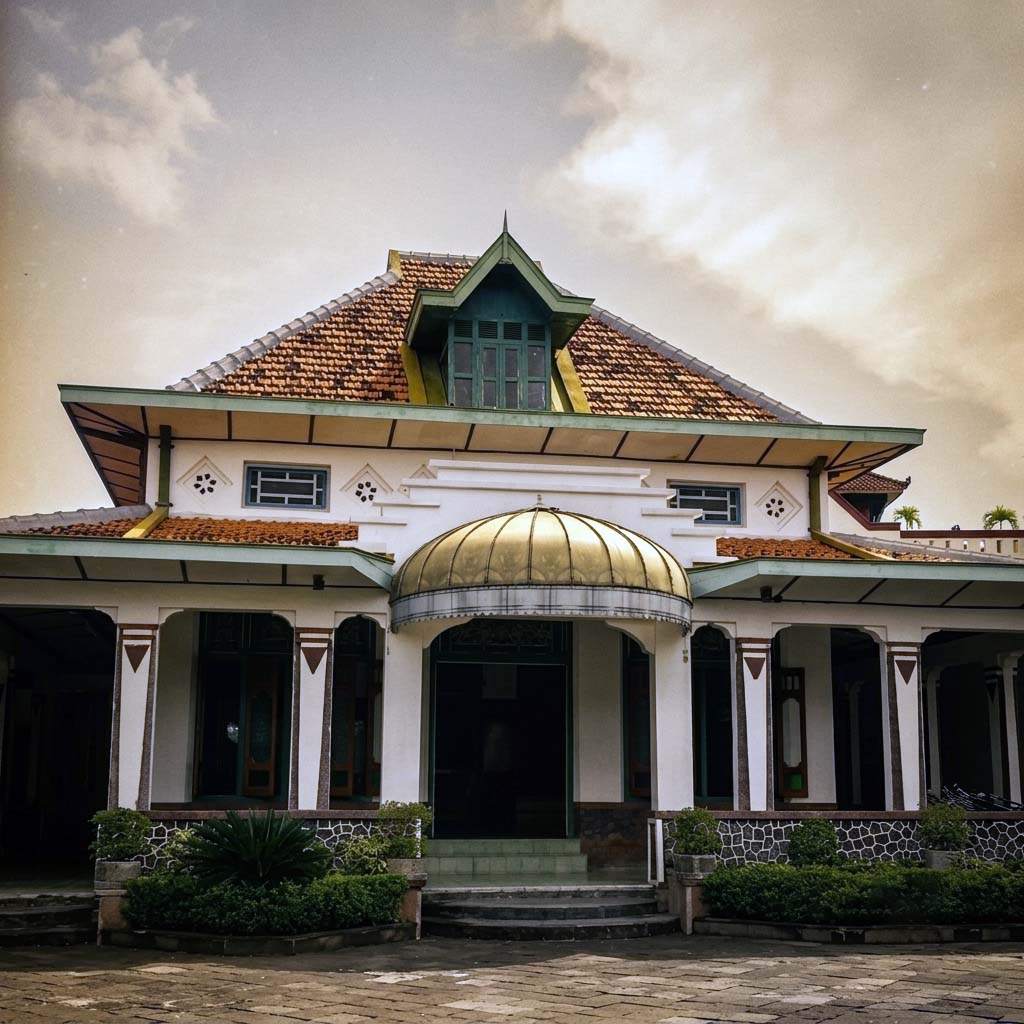
In the late 1800s, a distinct group of successful merchants known as the Wong Kalang began constructing mansions that challenged the aesthetic dominance of the joglo. These houses, which blend Javanese floor plans with European masonry, Chinese ornamentation, and Art Deco stained glass, represent a unique “eclectic” period in Javanese architectural history.10
| Architectural Element | Traditional Joglo | Kalang House |
| Foundation Material | Stone and Teak wood | Brick, cement, and European tiles.11 |
| Spatial Layout | Open pendopo (pavilion) | Enclosed front halls with stained glass.11 |
| Ornamentation | Carved Javanese motifs | Fusion of Dutch gables and Chinese ceramics.11 |
| Structural Vibe | Organic, open, and communal | Fortified, private, and opulent.11 |
The preservation of these buildings, many of which were damaged during the 2006 earthquake, has been a central focus of heritage organizations. The “Intro Living Museum Kotagede,” located within a historic Kalang mansion, now serves to interpret this complex architectural history for the public.10
The Spiritual Nexus: Masjid Gedhe and Pasarean Hastana Kitha Ageng Mataram
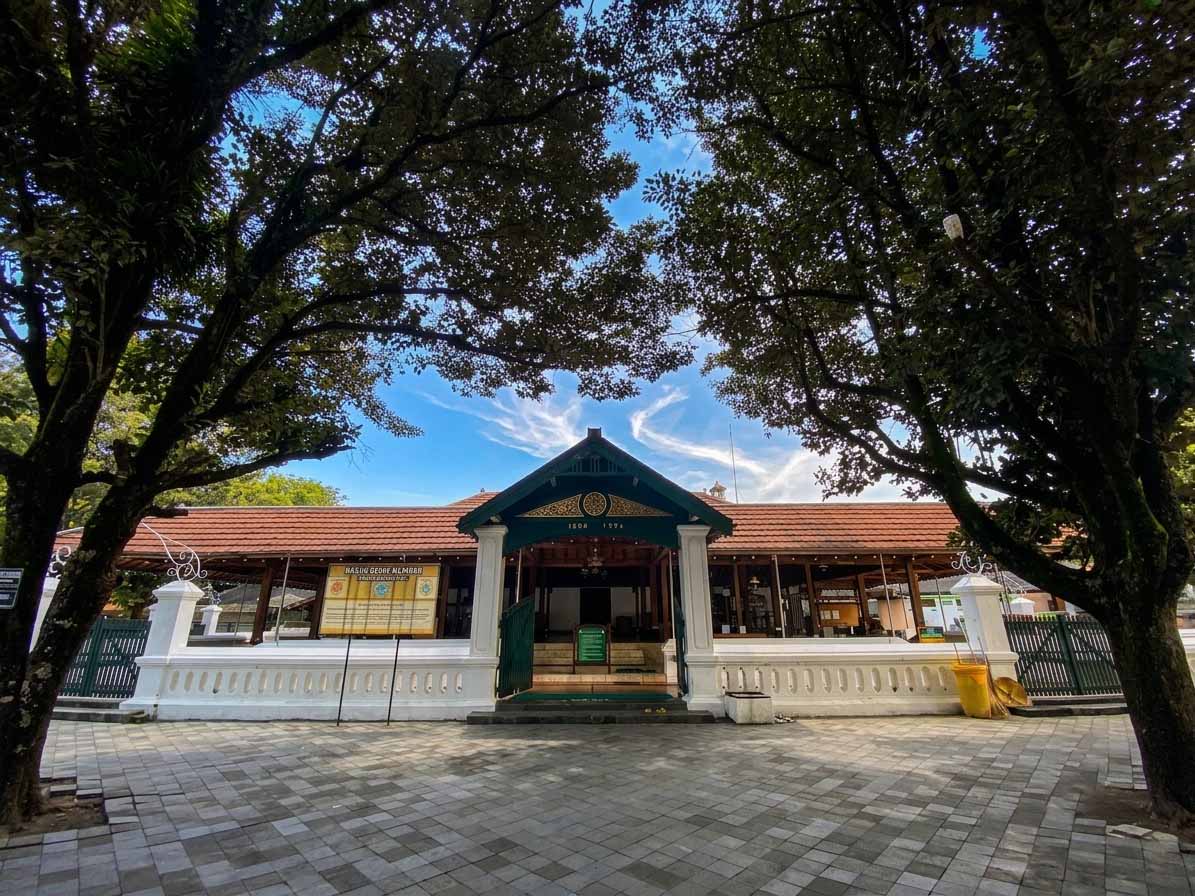
Kotagede remains a major center for Javanese pilgrimage, largely due to the presence of the Masjid Gedhe Mataram and the adjacent royal cemetery. These sites are not merely historical monuments but are active centers of ritual life that maintain the bond between the modern Javanese population and their ancestral rulers.1
Masjid Gedhe Mataram: The Oldest State Mosque
Completed in 1589, the Masjid Gedhe Mataram is the oldest mosque in the Yogyakarta region. Its architecture is a profound example of cultural synthesis, utilizing a triple-tiered tajug roof that predates the introduction of Middle Eastern domes to Indonesia.1 The mosque complex is entered through a gapura (gateway) constructed of red brick in a style that heavily resembles Hindu-Javanese temple entrances from the Majapahit era, signaling the continuity of sacred space across different religious epochs.4
Pasarean Hastana Kitha Ageng: Royal Funerary Traditions
The royal cemetery houses the tombs of Panembahan Senopati and his father, Ki Ageng Pamanahan, along with their families and successors.1 The site is managed by abdi dalem (palace retainers) from both the Yogyakarta and Surakarta palaces, who ensure that the strict protocols of royal etiquette are observed by all visitors.6
- Pilgrimage Rituals: Pilgrims visit to seek blessings, burn incense, and offer prayers. The atmosphere is one of extreme reverence, maintained by the presence of traditional guardians dressed in beskap and keris.6
- Sendang Seliran: South of the cemetery is a sacred spring believed to have been manifested by Panembahan Senopati. It contains two separate bathing pools for men and women and is home to a sacred yellow turtle that is said to be over a hundred years old.15
Visitor Protocols and Dress Codes
To enter the inner courtyard of the royal graves, visitors must adhere to traditional Javanese dress codes that have remained unchanged for centuries. This requirement is intended to erase modern status markers and bring the pilgrim into a state of ritual purity and humility.6
| Category | Requirement for Men | Requirement for Women |
| Main Garment | Kain jarik (batik wrap) and peranakan shirt.6 | Kemben (batik torso wrap).5 |
| Headwear | Head covering is optional but preferred. | No head covering (hijab must be removed).5 |
| Footwear | Must be removed before entering the courtyard.5 | Must be removed.5 |
| Prohibitions | No photography; no loud speaking.6 | No photography; no jewelry.6 |
Visiting hours for the inner graves are restricted to specific times on Mondays (10:00 AM – 12:00 PM), Fridays (1:30 PM – 4:00 PM), and Sundays.16 The mosque itself is open for the five daily prayers, but the sacred cemetery complex maintains its own guarded schedule.
The Silver Craft Industry: From Royal Patronage to Global Export
Kotagede’s identity as the “Silver Village” (Kampung Perak) is a legacy of its royal origins. When the Mataram court was established, there was an immediate need for skilled smiths to produce gold, copper, and silver objects for ceremonial use, including keris hilts, betel nut sets, and royal regalia.6
Historical Trajectory of the Industry
The silver industry has undergone several significant transformations over the last four centuries:
- The Formative Era (16th–18th Centuries): Production was almost exclusively dedicated to the palace. Artisans worked under royal protection, perfecting the repoussé technique to create complex floral and mythical motifs.20
- The Dutch Expansion (1930s): The industry was globalized during the colonial period. Mary Agnes Van Gesseler Versvir, the wife of the Dutch governor, played a pivotal role in organizing silversmiths into guilds and promoting their work in Europe.6
- The Filigree Revolution (1950s): In the mid-twentieth century, the filigree (fine wire) technique was introduced by craftsmen from Sulawesi. This allowed Kotagede to diversify its offerings, moving from heavy embossed items to delicate, lace-like jewelry.6
Technical Mastery: Repoussé and Filigree
Modern Kotagede silver is characterized by two distinct methods of manufacture, both of which require immense patience and manual precision 6:
- Repoussé (Embossing): A technique where the silver is hammered from the back to create a three-dimensional relief on the front. This is commonly used for large decorative items like bowls, wall hangings, and tea sets.6
- Filigree: This involves twisting and weaving extremely fine silver wires (often 925 sterling grade) into intricate patterns. The wires are soldered together to form a delicate structure, often featuring the lotus flower or tendril motifs characteristic of Javanese art.20
Key Industry Leaders and Studios
The silver industry today is a mix of large-scale exporters and boutique educational studios.
- HS Silver: One of the oldest and most prominent brands, established in 1953. It maintains a large showroom on Jalan Mondorakan and is known for its high-quality filigree and commitment to environmental sustainability through waste reduction.22
- Ansor’s Silver: Founded in 1956, this company is famous for its location in a historic Dutch-colonial building and its wide range of miniatures, such as silver bicycles and horse-drawn carriages.12
- Studio 76: A pioneer in “creative tourism,” Studio 76 offers participatory workshops where tourists can spend a few hours or a full day designing and crafting their own silver rings or pendants under the guidance of master smiths.24
Despite its former glory, the industry has faced challenges since the 1990s due to the rising cost of raw silver and a decline in interest among the younger generation. Current initiatives focus on “Experience Economy” models, where the process of making silver becomes as much of a product as the silver itself.20
Markets and Daily Life: The Role of Pasar Legi
Pasar Legi remains the beating heart of Kotagede’s economy and a vital site of intangible cultural heritage. Established around 1549 by Ki Ageng Pamanahan, it is the oldest traditional market in the Yogyakarta region.5 The market is not merely a place of commerce but a social theater where the traditional Javanese calendar dictates the rhythm of life.
The Javanese Market Cycle
While the market operates daily, it reaches its peak activity on “Legi” days of the five-day Javanese week (Pasaran). On these days, traders from across Central Java descend on Kotagede to sell livestock, batik, traditional medicines (jamu), and artisanal tools.5 This cycle ensures that the market remains a regional hub rather than just a local convenience store.
Culinary Heritage: The Semiotics of Snacks
The culinary scene in Kotagede is a repository of historical flavors, with many of its signature snacks having been developed for the royal court centuries ago.3
| Specialty | Key Ingredients | Cultural Context |
| Kipo | Glutinous rice, coconut, palm sugar, pandan leaf.5 | Small, green, and grilled; its name is a contraction of “Iki opo?” (What is this?).3 |
| Kembang Waru | Flour, eggs, sugar.5 | A soft cake shaped like the Waru leaf (hibiscus), symbolizing prosperity and historical royal favor.3 |
| Legomoro | Sticky rice and meat.5 | Wrapped in banana leaves and tied with bamboo strips; symbolizes a peaceful heart (lego mo-ro).5 |
| Yangko | Glutinous rice flour and sugar.5 | Often called the “Javanese Mochi,” it was historically a staple food for soldiers due to its long shelf life.3 |
The survival of these foods is largely due to the “Kampung” home industry system, where families specialize in a single recipe for generations, supplying Pasar Legi and the wider Yogyakarta market.3
Mythology and Collective Memory
The physical structures of Kotagede are animated by a rich layer of folklore and mystical beliefs that continue to shape the community’s identity. The most prominent of these is the legend of Kanjeng Ratu Kidul, the Queen of the Southern Sea.7
The Spiritual Consort of Mataram
Javanese mythology holds that Panembahan Senopati entered into a spiritual marriage with Ratu Kidul to secure supernatural support for his kingdom. This alliance is not viewed as a mere ghost story but as a fundamental pillar of Mataram’s sovereignty, linking the inland power of the Sultanate with the cosmic forces of the ocean.7 Annual offerings (Labuhan) and specific rituals at sites like Parangkusumo beach reinforce this link between the royal family of Yogyakarta and the spiritual realm.
Localized Folklore
Beyond the royal myths, Kotagede is home to more localized tales:
- Tunggulwulung: A mythical fish believed to inhabit the sacred springs and assist the kings in times of crisis.5
- The Guardians of the Spring: The catfish (lele) and turtles in Sendang Seliran are considered sacred and are never eaten. Their presence is thought to ensure the continued flow of the spring water and the health of the community.15
- The Throne of Watu Gilang: A large black stone believed to be the throne of Panembahan Senopati. Local lore says that the dents in the stone were created when Senopati smashed the head of a rebellious vassal against it, demonstrating his absolute power.3
These stories are maintained through oral tradition and are a major draw for domestic tourists seeking to “feel” the spiritual energy (aura) of the old capital.7
Disaster, Recovery, and the “Living Museum” Movement
The modern era for Kotagede was defined by the catastrophic earthquake of May 27, 2006. The disaster destroyed hundreds of historic buildings, including many of the district’s most iconic joglo houses and portions of the Masjid Gedhe complex.3
Post-Earthquake Revitalization
The recovery process served as a catalyst for a new approach to heritage management. Rather than just rebuilding, the focus shifted to the “Living Museum” concept, which emphasizes that heritage is not just in buildings but in the living traditions of the people.4
- International Support: The World Monuments Fund (WMF) and UNESCO provided guidelines for the resilient restoration of traditional wooden houses, ensuring they could survive future seismic events.4
- Omah UGM: A damaged joglo complex owned by Gadjah Mada University was restored to serve as a research hub and a demonstration site for traditional architecture. It is now open to the public as a “witness” to the 2006 disaster and the subsequent recovery.9
- Community Involvement: Programs like Pusaka Jogja Bangkit brought together local residents, academics, and the government to document intangible assets—such as culinary recipes and silver techniques—that were at risk of being lost in the chaos of reconstruction.26
| Project Name | Lead Organization | Focus Area |
| Intro Living Museum | Cultural Office of DIY | Multimedia interpretation of Kotagede history.10 |
| Jogja Heritage Track | Yogyakarta Government | Connectivity between heritage sites via specialized buses.21 |
| Kampung Penjaga Pusaka | Purbayan Tourism Village | Local community patrol and maintenance of historic sites.3 |
Tourism and Heritage Experiences
Today, Kotagede is a primary destination for travellers seeking an authentic alternative to the more commercialized areas of Yogyakarta like Malioboro. The district offers a range of immersive experiences that benefit from its compact, walkable geography.1
Specialised Walking Tours
Given the narrow alleys (gangs) that define Kotagede, the most effective way to see the district is on foot. Guided “Heritage Walks” often focus on the following clusters 7:
- The Royal Core: Including the mosque, the cemetery, and the Alun-Alun. This area emphasises Javanese history and spiritualism.7
- The Merchant Quarter (Jagalan): Featuring the Kalang mansions and the “Between Two Gates” (Antara Dua Pintu) architecture, where private courtyards serve as public thoroughfares.7
- The Craft Alleys: Focused on the silver workshops and the “Pandheyan” areas where artisans can still be seen working in their home studios.1
The Role of Surjan Tour and Professional Guidance
For international and domestic travellers, navigating the complex social and spiritual protocols of Kotagede is often best achieved through specialised tour operators. Surjan Tour, established in 2004, functions as an “authentic bridge” to the heart of Java, offering customised itineraries that go beyond superficial sightseeing.28
Professional guides are essential for several reasons:
- Language and Storytelling: Many of the most significant sites, like Watu Gilang or the private chambers of Kalang houses, require deep historical context that is not provided on signage.7
- Access and Etiquette: Guides facilitate the rental of traditional clothing for the cemetery and ensure that visitors adhere to local customs, preventing cultural friction.6
- Logistics: Surjan Tour provides comfortable transportation—ranging from Toyota Avanzas to larger Hiace vans—which is crucial for groups travelling from central Yogyakarta or the airport.28
Conclusion: Synthesising the Kotagede Experience
Kotagede represents the enduring spirit of the Javanese people—a community that has survived the rise and fall of empires, the pressures of colonialism, and the devastation of natural disasters. Its significance lies not in any single monument, but in the seamless integration of the sacred and the profane. It is a place where a silversmith might work on an order for a European jewellery house in the shadow of a sixteenth-century mosque, or where a pilgrim might buy a sacred snack after praying at the tomb of a king.1
As the district moves forward, the challenge remains the preservation of its “living” character. Heritage is not merely a collection of old buildings; it is the smell of palm sugar in a Kipo workshop, the sound of a silversmith’s hammer at dawn, and the collective memory of a kingdom that once ruled the island. For the visitor, Kotagede is more than a tourist destination—it is a temporal journey into the very foundation of Javanese identity. By supporting local artisans, respecting sacred sites, and engaging with professional tour services like Surjan Tour, travellers contribute to the continued survival of this unique urban palimpsest.10
Works cited
- Discover Kotagede: Yogyakarta’s Historic Silversmith Village – Bali Star Island, accessed May 4, 2026, https://balistarisland.com/yogyakarta-tourist-attractions/kotagede/
- Mataram | Lombok, Yogyakarta & Bali – Britannica, accessed May 4, 2026, https://www.britannica.com/place/Mataram-historical-kingdom-Indonesia
- Journal of Tourism Sciences (Toursci) Kotagede Heritage City – Ann Publisher, accessed May 4, 2026, https://annpublisher.org/ojs/index.php/toursci/article/download/201/203
- Kotagede Heritage District – World Monuments Fund, accessed May 4, 2026, https://www.wmf.org/monuments/kotagede-heritage-district
- Exploring Kotagede’s Traditional Culinary Tourism Strategy as a Culture and Tourism Reinforcement in Yogyakarta – International Journal of Recent Technology and Engineering (IJRTE), accessed May 4, 2026, https://www.ijrte.org/wp-content/uploads/papers/v8i1C2/A11060581C219.pdf
- The case of Kotagede, Yogyakarta, accessed May 4, 2026, https://ebrary.net/213114/education/case_kotagede_yogyakarta
- Rumah Tradisional Milik Universitas Gadjah Mada – JOGJACAGAR | Sistem Informasi Cagar Budaya, accessed May 4, 2026, https://jogjacagar.jogjaprov.go.id/detail/782/rumah-tradisional-milikugm
- Kotagede Intro Living Museum: Culture and History Yogyakarta – Indonesia Travel, accessed May 4, 2026, https://www.indonesia.travel/gb/en/destination/java/yogyakarta/kotagede-intro-living-museum/
- Kotagede Museum: Intro Living Museum – Yogyakarta Tourism Portal – Visiting Jogja, accessed May 4, 2026, https://visitingjogja.jogjaprov.go.id/en/18461/kotagede-museum-intro-living-museum/
- Ansor`s Silver – JogjaBagus, accessed May 4, 2026, https://jogjabagus.id/business/ansors-silver
- Pilgrimage – JESEDU-Jogja2024, accessed May 4, 2026, https://www.jesedu-jogja2024.educatemagis.org/page-participants-pilgrimage/
- Kota Gede Royal Cemetary – Jogjakarta Tourism, accessed May 4, 2026, https://jogja.info/html/kotagede.htm
- Jurnal Ilmu Ekonomi dan Pembangunan – Semantic Scholar, accessed May 4, 2026, https://pdfs.semanticscholar.org/7d71/31cb9f9208a34c4ce0198e72320e0269c4d7.pdf
- Geographical Indication Protection on Local Product: Kotagede Silver – Atlantis Press, accessed May 4, 2026, https://www.atlantis-press.com/article/125935416.pdf
- Kotagede Silver Craft Center – Yogyakarta Tourism Portal – Visiting Jogja, accessed May 4, 2026, https://visitingjogja.jogjaprov.go.id/en/18471/kotagede-silver-craft-center/
- HS Silver, Company in Yogyakarta | Online-store HS Silver, Company Yogyakarta (Indonesia) – ALL.BIZ, accessed May 4, 2026, https://8049-id.all.biz/
- Kotagede: A Silver Legacy, Preserving Tradition in Yogyakarta – RRI.co.id, accessed May 4, 2026, https://rri.co.id/en/art-and-culture/1255465/kotagede-a-silver-legacy-preserving-tradition-in-yogyakarta
- Creative Economy Development at Silver Studio 76 Using Experience Economy for Silver Craft Preservation in Kotagede – Online Journal of ISI Yogyakarta, accessed May 4, 2026, https://journal.isi.ac.id/index.php/TUMATA/article/download/15928/4373
- Art Studio 76 – A studio to learn how to make silver jewellery, accessed May 4, 2026, https://www.artstudio76.com/
- Managing Heritage Cities in Asia and Europe: The Role of Public-Private Partnerships – International National Trusts Organisation, accessed May 4, 2026, https://www.into.org/app/uploads/2020/11/Indonesia-Kotagede.pdf
- Omah UGM Offers Journey Through Javanese Architecture, Culture – RRI.co.id, accessed May 4, 2026, https://rri.co.id/en/tourism/1405531/omah-ugm-offers-journey-through-javanese-architecture-culture
- Surjan Tour – Yogyakarta Tour Operator & Java Overland Specialist …, accessed May 4, 2026, https://surjantour.com/


Maybe you are interested in reading the following article:
Surjan : A Deep Study Javanese Traditional Garment
Learn about Surjan, Yogyakarta’s traditional Javanese attire. Discover its history, symbolism, cultural values, and role in palace traditions. read more
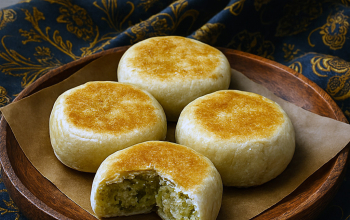
Bakpia Jogja
Discover Bakpia Jogja’s history, culture, flavors, UMKM impact, and tourism role. Explore Yogyakarta’s iconic pastry loved by travelers worldwide. read more
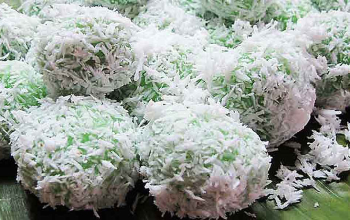
Klepon: History, Cultural Identity, and Evolution of Indonesia’s Iconic Sweet Treat
Klepon — bright green, chewy rice-flour balls filled with molten palm sugar and coated in freshly grated coconut. most beloved traditional sweets. read more

Traditional Culinary Souvenirs from Yogyakarta: Authentic Tastes to Take Home
Traditional Culinary Souvenirs from Yogyakarta: Authentic Tastes to Take Home Published by: Surjan Tour| Date: October 25, 2025 Introduction: Bringing the Taste of Jogja Home Yogyakarta, affectionately known as Jogja, is a city where culture, tradition, and flavor come together in perfect harmony. For visitors, it’s not just the temples and heritage that l... read more




Contact Us
If you have any questions, please contact us.
-
Hotline
+6281578701572 -
Whatsapp
+6281578701572 -
Messenger
Surjantour -
Email
surjantoursales@gmail.com


No comment yet