
The Cultural, Historical, and Medicinal Heritage of Wedang Uwuh
16 November 2025 81x Food & Beverages, Heritage
The Cultural, Historical, and Medicinal Heritage of Wedang Uwuh from Imogiri, Yogyakarta
Introduction
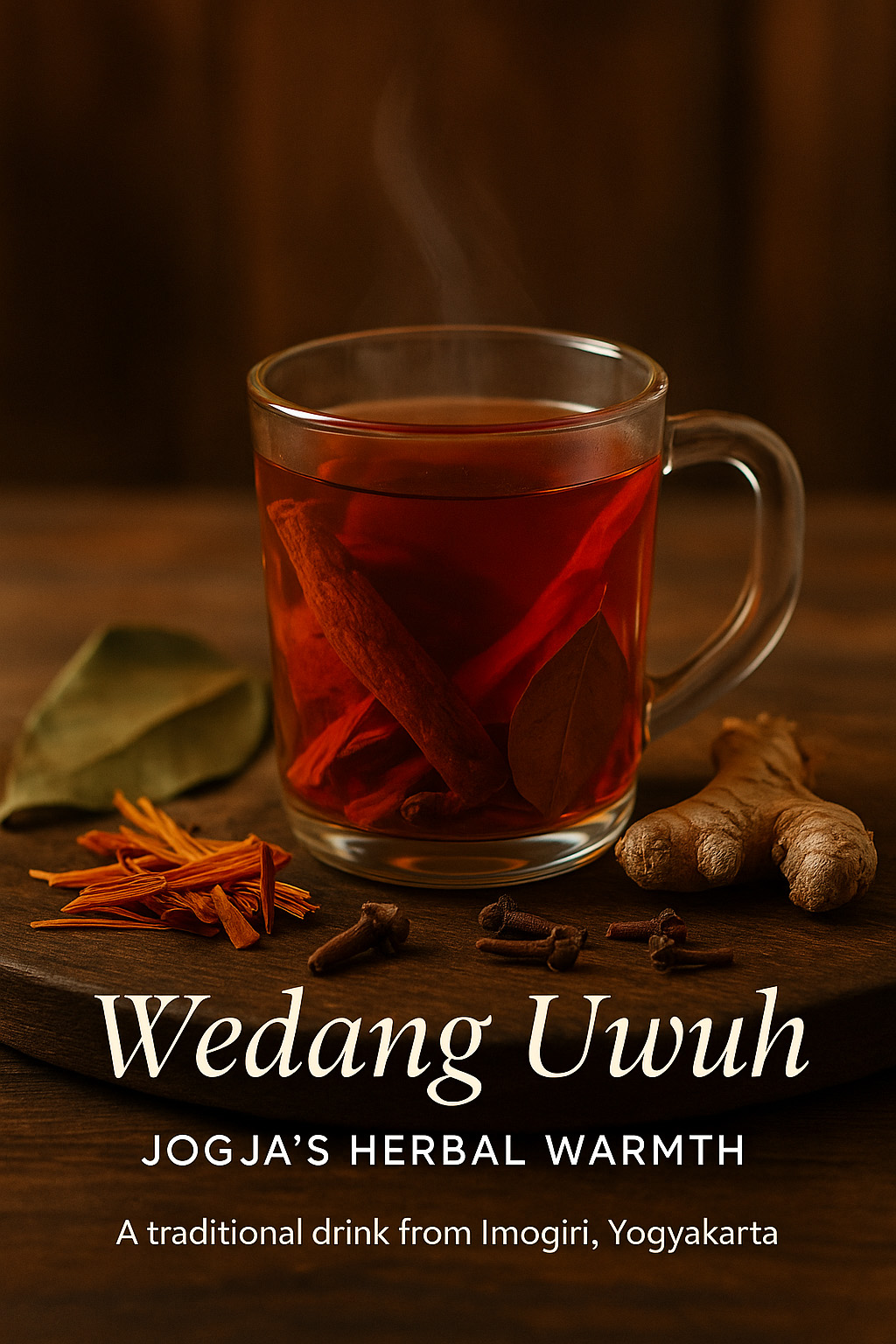
Nestled in the serene hills of Imogiri, Bantul Regency (Yogyakarta, Indonesia), lies a deceptively simple yet deeply symbolic herbal infusion known as Wedang Uwuh. In Javanese, “uwuh” literally means “trash” or “waste,” a name inspired by the appearance of its dried leaves and spices, which resemble leaf litter. But behind that humble name hides a rich tapestry of royal history, spiritual tradition, community wisdom, and medicinal potency.
Wedang Uwuh is more than a beverage: it is a living artefact of Javanese culture. It weaves together the story of the Mataram Sultanate, pilgrimage rituals at the royal Imogiri tombs, traditional jamu (herbal medicine), small-scale entrepreneurship, and modern wellness tourism. Scientific studies have confirmed its antioxidant, anti-inflammatory, and antimicrobial properties, giving it new life in the global herbal and functional beverage market.
This article explores Wedang Uwuh in depth: its origins, symbolism, ritual function, health benefits (backed by research), economic and tourism impact, preservation challenges, and future prospects.
Historical Origins and Royal Roots of Wedang Uwuh
Imogiri and the Mataram Sultanate Legacy
The story of Wedang Uwuh begins in Imogiri, the sacred burial ground (Astana) of the kings of the Mataram Sultanate—a powerful Javanese polity that reached its apex in the 17th century. Imogiri itself is more than a cemetery: it is a spiritual complex, a site of royal memory, and a place of pilgrimage. Source: Wikipedia – Imogiri.
Legend holds that Sultan Agung Hanyakrakusuma, the great ruler of Mataram, once retired under a tree at Imogiri to meditate. While drinking a hot traditional herbal beverage (wedang secang), fallen leaves and twigs were blown into his cup by the wind. Instead of discarding the mixture, Sultan Agung tasted it and found it unexpectedly pleasant and comforting. Courtiers replicated the accidental blend, adding other locally available herbs, creating what we now call Wedang Uwuh. This narrative is preserved in local oral histories and cultural commentary. Source: Telkomsel Jelajah.
Over time, this herb-infused drink became associated with the tomb complex. Pilgrims visiting Imogiri consumed it as a warming, revitalising beverage after their steep climb to the royal graves. As documented in local Imogiri tourism resources, Wedang Uwuh remains popular among ziarah (pilgrimage) visitors. Source: Makam Imogiri Tourism.
Naming, Symbolism, and Philosophical Meaning
The term “uwuh” refers to the visual chaos of dry leaves and rempah (spice) bits in the hot brew—what looks like refuse is in fact a carefully balanced fusion of nature’s gifts. In Javanese culture, this paradox carries profound meaning: the humble and discarded, when harmonised, become a source of nourishment and wholeness. Scholars have noted that this naming reflects resourcefulness, humility, and environmental respect. Source: Archaeology Journal, Kemdikbud.
Historical documentation and archival research show that Imogiri’s residents and palace attendants (abdi dalem) collected fallen spices—clove leaves, secang bark, bits of ginger—and brewed them into tea. Reference: Kemendikdasmen Repository.
Thus, Wedang Uwuh is not just herbal medicine but a living symbol of Javanese cosmology, where the neglected and overlooked converge into something harmonious and sacred.
Cultural Significance, Ritual Usage & Philosophical Dimensions
Symbolism Embedded in Its Ingredients
Each herb in Wedang Uwuh carries spiritual and symbolic meaning:
- Secang wood (Caesalpinia sappan): Its deep red color represents strength, protection, and vitality—qualities associated with masculine energy in Javanese cosmology.
Reference: Archaeology Journal. - Ginger (Zingiber officinale): Signifies warmth and purification. In traditional practice, ginger is used to cleanse the body and aid spiritual meditation.
Commentary: Kompas Klasika. - Clove leaves (Syzygium aromaticum): They represent fertility, prosperity, and ancestral blessing. Their fallen leaves echo humility, as blessings come even from what is discarded.
Source: Kemendikdasmen Repository. - Cinnamon (Cinnamomum burmannii): Symbolizes balance, domestic peace, and emotional harmony in communal Javanese life.
Reflection on cinnamon symbolism: Kompas Food. - Cardamom (Elettaria cardamomum): Linked to clarity of thought, intellectual purity, and spiritual articulation. Historically used by Javanese scholars and spiritual seekers.
Reference: Bantul Regency Government.
Together, these ingredients embody the Javanese ideal of manunggaling rasa — the unity of feeling, nature, and spirit.
Ritual Context and Pilgrimage Tradition
Wedang Uwuh remains deeply embedded in the spiritual practices of Imogiri pilgrims. Visitors ascending to the tomb complex often partake in the drink, using it:
- As a physical aid—warming the body after climbing toward the graves.
- As a spiritual grounding—connecting the pilgrim with royal ancestors.
- As a symbolic offering—serving as a humble tribute of nature to the sacred site.
Local traditions also interpret Wedang Uwuh as a form of sedekah alami (nature’s offering), where fallen leaves become a gift back to the living. Elders explain that brewing and consuming the drink is a gesture of respect to nature’s cycle.
Philosophical Narratives — The Teachings of Sultan Agung
The origins of Wedang Uwuh in the reign of Sultan Agung give it a royal-philosophical dimension. As portrayed in Javanese chronicles, Sultan Agung valued simplicity, ascetic discipline, and harmony with the natural world. His choice to consume a rustic brew — even when accidentally concocted — aligns with his moral teachings about humility, patience, and connection to the divine.
Local historians suggest that Wedang Uwuh is more than medicine; it carries the ethos of “hamemayu hayuning bawana”—a Javanese principle encouraging individuals to contribute to cosmic harmony and social balance.
Social Practice & Communal Sharing
In the villages around Imogiri, Wedang Uwuh is a communal experience. It is brewed and shared:
- Among farmers after a long day’s work
- During ziarah rest stops
- At local markets
- During cultural gatherings and folk festivals
This practice fosters guyub rukun (togetherness) — a core Javanese social value. The resurgence of vendors like Mbah Sudi, documented by the Bantul Regency Government, highlights how Wedang Uwuh is not only a tradition but a living act of community resilience and identity.
Source: Bantul Regency.
Scientific Research & Medicinal Benefits of Wedang Uwuh
Phytochemicals and Bioactive Components
Modern research has revealed that Wedang Uwuh is rich in bioactive compounds with therapeutic potential. Analytical techniques like HPLC, GC-MS, and spectrophotometry have identified:
- Brazilin & Brazilein from secang wood — high antioxidant content and anti-inflammatory efficacy.
Source: Undip Journal – IJPB. - [6]-Gingerol, [6]-Shogaol from ginger — contributes to digestive health, metabolic regulation, and immune modulation.
Source: NCBI. - Eugenol from clove leaves — potent antimicrobial and anti-inflammatory agent.
Source: ScienceDirect Article. - Cinnamaldehyde and polyphenols from cinnamon — implicated in blood sugar regulation, antioxidant activity, and vasodilation.
Source: NCBI. - Terpenes and flavonoids in cardamom — contribute to digestive and respiratory wellness.
Source: ScienceDirect.
Evidence from Wedang Uwuh-Specific Studies
Researchers in Indonesia have conducted targeted studies on Wedang Uwuh itself, not just its individual components:
- Antioxidant Capacity: Studies at Universitas Gadjah Mada show IC₅₀ values below 100 ppm, indicating very strong free-radical scavenging when steeped optimally (10–15 minutes).
Source: Pharmacy Science Journal. - Antidiabetic Effects: Animal experiments demonstrate that Wedang Uwuh extracts can lower blood sugar, improve insulin sensitivity, and reduce oxidative stress in pancreatic tissue.
Source: Unimus Journal. - Anti-inflammatory & Cardiovascular Benefits: The synergy of ginger, secang, and cinnamon helps reduce inflammation markers and supports vascular health.
Source: MDPI – Antioxidants Journal. - Antimicrobial Activity: Wedang Uwuh shows inhibitory action against E. coli, Staphylococcus aureus, and Candida albicans.
Source: Metamorfosa Journal, Universitas Udayana.
Health Benefits Confirmed by Research
Based on these phytochemical and experimental studies, Wedang Uwuh offers multiple health benefits:
- Immune support — phenolics boost antioxidant defense.
- Anti-inflammatory action — reduces chronic inflammation risk.
- Blood sugar regulation — helps modulate glucose metabolism.
- Cardiovascular support — improves circulation, reduces oxidative stress.
- Digestive aid — ginger and cardamom ease digestion, nausea.
- Antimicrobial effects — contributes to oral and gut health.
This robust scientific validation enhances Wedang Uwuh’s appeal as a functional herbal beverage for both traditional and modern consumers.
Cultural-Scientific Convergence
The scientific recognition of Wedang Uwuh does not replace its cultural significance—it enriches it. This convergence of tradition and evidence positions Wedang Uwuh as a heritage drink with credible wellness credentials. It offers a compelling narrative for global consumers who value authenticity, history, and health.
Economic, Tourism & Market Impact of Wedang Uwuh
MSME Development and Local Livelihoods
Wedang Uwuh has become a valuable product for UMKM (micro, small, and medium enterprises) in Yogyakarta, particularly in the villages surrounding Imogiri. The drink’s natural ingredients are locally available, which keeps production costs low and supports local employment.
- Many producers are small-scale family businesses, often female-led, preserving traditional recipes while earning income.
Source: UNAS Journal on MSME. - The rise of e-commerce (Tokopedia, Shopee, Instagram shops) has enabled local sellers to reach national and international customers, boosting sales and encouraging product standardization.
Source: UI Digital Economy Journal.
Cultural Tourism and Heritage Experience
Wedang Uwuh is now embedded in the tourism offer of Yogyakarta:
- At Imogiri Royal Cemetery, visitors often taste the drink as part of guided heritage tours, connecting the physical pilgrimage with a symbolic, flavorful experience.
Source: UNY Tourism Studies Journal. - Yogyakarta’s cultural tourism strategy promotes Wedang Uwuh in food festivals and culinary routes—drawing tourists who are interested in royal traditions, wellness, and Javanese philosophy.
Source: UST Yogyakarta Journal. - With growing demand for wellness tourism, Wedang Uwuh fits seamlessly into eco-retreats, herbal workshops, and wellness tours.
Source: ScienceDirect – Tourism & Wellness.
Innovations and Global Market Expansion
To meet modern demand, Wedang Uwuh producers have innovated:
- Packaging: tea bags, sachets, ready-to-drink bottles, freeze-dried blends.
- Product variants: herbal lattes, carbonated infusions, mocktails, syrups, dessert infusions.
- Quality standards: some producers pursue BPOM registration, halal certification, and GMP compliance to enter export markets.
Source: Pharmacy Journal on Standardization.
The global herbal tea market is projecting strong growth, particularly for traditional beverages with wellness credentials. Wedang Uwuh, with its unique red color, royal history, and scientifically validated benefits, has strong export potential to countries like Japan, the U.S., South Korea, and the EU.
Source: ScienceDirect – Herbal Tea Market Analysis.
Sustainable and Community-Based Model
Because Wedang Uwuh uses renewable, locally grown herbs (secang, ginger, clove, cinnamon), it supports agroforestry around Imogiri. This contributes to:
- sustainable land use,
- ecological resilience,
- community income generation,
- preservation of cultural plant species.
Reference on sustainable herbal agriculture: IPB Journal on Agroforestry.
Preservation, Challenges & Future Policy Directions
Heritage Preservation Challenges
Wedang Uwuh faces risks as it enters modern markets:
- Loss of authenticity – mass production may compromise taste, ritual value, and traditional preparation.
Study: UGM Wisdom Journal. - Ingredient scarcity – urban expansion threatens herb-growing land, reducing secang and ginger supply.
Research on land use: UGM Land-Use Journal. - Cultural disconnect – younger generations may prefer modern beverages, risking a decline in traditional consumption.
Insight: UNY Youth Journal.
Strategies for Cultural and Economic Preservation
To safeguard both heritage and potential, the following strategies are vital:
- Geographical Indication (GI): Register Wedang Uwuh as a GI product to protect its origin, branding, and authenticity.
Reference: WIPO GI Case Study. - Community Workshops & Tourism Integration: Host brewing workshops, herb-foraging tours, storytelling sessions, and heritage festivals to revitalize local knowledge and attract cultural tourists.
Reference: ScienceDirect Cultural Tourism Study. - Agroforestry & Sustainable Herb Farming: Encourage planting of secang, clove, ginger in sustainable agroforestry systems. Align with global sustainability goals.
Framework: UN SDG – Responsible Consumption. - Support for MSMEs: Provide training for small producers in quality control, certification (BPOM, halal), packaging, and digital marketing.
Policy model: IPB Journal on MSME Policy. - Herbal Innovation Centers: Universities and research institutions should collaborate on herbi-R&D centers to conduct standardization, clinical research, and sustainable breeding.
Reference: UGM Herbal R&D Paper.
Future Research & Academic Opportunities
As Wedang Uwuh continues to gain prominence, future scholarship and innovation can explore:
- Clinical trials — Human studies on metabolic, cardiovascular, and immunological outcomes to validate traditional claims.
Suggested path: Align with global research standards.
Reference: ScienceDirect Clinical Research Review. - Genetic diversity studies — Investigate the genetic variation of Caesalpinia sappan (secang) in Indonesia to promote sustainable cultivation and conservation.
Reference: IPB Genetic Plant Journal. - Comparative ethnobotany — Compare Wedang Uwuh with herbal traditions from other cultures (Thai decoctions, Japanese kampo, Indian ayurvedics) to identify common patterns and global relevance.
Reference: ScienceDirect Cross-Cultural Studies. - Consumer behavior research — Understand how global and domestic consumers perceive Wedang Uwuh: flavor preferences, cultural meaning, packaging expectations, purchase behavior.
Reference: ScienceDirect Herbal Tea Market Report.
Conclusion
Wedang Uwuh is not simply a herbal drink—it is a living legacy, deeply rooted in Javanese royal tradition and contemporary wellness culture. From the sacred hills of Imogiri and the legacy of Sultan Agung to the laboratories validating its antioxidant power, Wedang Uwuh bridges past and future, culture and science, spirituality and commerce.
To ensure this heritage remains vibrant, coordinated efforts are needed: from heritage protection (GI) and community tourism initiatives to MSME empowerment, agroforestry, and academic research. With the right policies and sustainable innovation, Wedang Uwuh can truly travel beyond Imogiri—into global teacups, wellness retreats, heritage circuits, and scientific discourse.
Its journey is not just about preserving a drink, but about nurturing a cultural ecosystem—one where fallen leaves, humble herbs, and centuries-old wisdom flow into a cup that warms the body, nourishes the spirit, and tells a story.
References
- Telkomsel Jelajah. Sejarah Wedang Uwuh, Jelajah Nusantara Yogyakarta.
https://www.telkomsel.com/jelajah/jelajah-nusantara/jelajah-jogja/sejarah-wedang-uwuh-minuman-favorit-raja-mataram - Imogiri Royal Cemetery Tourism. Kuliner Wedang Uwuh.
https://makamimogiri.bantulkab.go.id/page/detail/2022000021/kuliner.html - Archaeology Journal, Kemdikbud. Artikel Arkeologi & Wedang Uwuh.
https://berkalaarkeologi.kemdikbud.go.id/index.php/berkalaarkeologi/article/download/567/899 - Kemendikdasmen Repository: Jantra, Vol. 9, No. 1 – Filosofi Rempah Wedang Uwuh.
https://repositori.kemendikdasmen.go.id/5131/1/Jantra_Vol._9_No._1_Juni_2014.pdf - Kompas Klasika. Wedang Uwuh: Racikan Rempah Nusantara yang Menyegarkan.
https://klasika.kompas.id/baca/wedang-uwuh-racikan-rempah-nusantara-yang-menyegarkan/ - Kompas Food. Sejarah Wedang Uwuh, Minuman Tradisional dari Bantul Yogyakarta.
https://www.kompas.com/food/read/2022/03/06/100700475/sejarah-wedang-uwuh-minuman-tradisional-dari-bantul-yogyakarta - Bantul Regency Government. Nikmatnya Wedang Uwuh Mbah Sudi (Warisan Imogiri).
https://bantulkab.go.id/berita/detail/4435/nikmatnya-wedang-uwuh-mbah-sudi–minuman-segar-penjaga-stamina-khas-imogiri.html - Journal of Pharmacy Science. Antioxidant Activity of Wedang Uwuh (IC50 Study).
https://journal.farmasi.or.id/index.php/pharmascien/article/view/739 - Universitas Islam Muhammadiyah Semarang (UNIMUS). Antidiabetic Effects in Animal Study.
https://jurnal.unimus.ac.id/index.php/psn12012010/article/view/4144 - MDPI – Antioxidants Journal: Anti-Inflammatory Effects of Wedang Uwuh Ingredients.
https://www.mdpi.com/2076-3921/9/10/979 - Metamorfosa Journal – Universitas Udayana. Antimicrobial Potential of Wedang Uwuh.
https://ojs.unud.ac.id/index.php/metamorfosa/article/view/77966 - UGM PCD Journal. Cultural Economy of Yogyakarta and Traditional Herbs.
https://journal.ugm.ac.id/pcd/article/view/78194 - UNAS Journal on MSME Development. Herbal UMKM in Yogyakarta.
https://jurnal.pasca.unas.ac.id/ojs/index.php/jurnal/article/view/207 - UI Journal of Digital Economy. Digital Transformation of Traditional MSMEs.
https://journal.ui.ac.id/index.php/jdem/article/view/16470 - UNY Journal of Tourism & Heritage. Integration of Wedang Uwuh in Heritage Tourism.
https://journal.uny.ac.id/index.php/jpji/article/view/52599 - UST Yogyakarta Journal. Culinary Tourism Strategy in Bantul.
https://jurnal.ustjogja.ac.id/index.php/jip/article/view/11195 - ScienceDirect – Tourism & Wellness. Herbal-Based Wellness Tourism Trends.
https://www.sciencedirect.com/science/article/pii/S2211973623000210 - Pharmacy Journal – Herbal Product Standardization in Indonesia.
https://journal.farmasi.or.id/index.php/jff/article/view/2483 - ScienceDirect – Herbal Tea Market Analysis.
https://www.sciencedirect.com/science/article/pii/S0963996922001364 - IPB Journal – Sustainable Herbal Agriculture.
https://journal.ipb.ac.id/index.php/jepi/article/view/45645 - UGM Wisdom Journal. Commodification Risks in Javanese Culinary Heritage.
https://journal.ugm.ac.id/wisdom/article/view/75410 - UGM Journal on Land Use. Land-Use Change in Imogiri Region.
https://jurnal.ugm.ac.id/jsp/article/view/64077 - UNY Journal – Youth Cultural Trends.
https://journal.uny.ac.id/index.php/mip/article/view/64765 - WIPO Magazine. Geographical Indication Protection Case Study.
https://www.wipo.int/wipo_magazine/en/2019/01/article_0006.html - ScienceDirect – Cultural Tourism Study.
https://www.sciencedirect.com/science/article/pii/S2211973623000295 - UN Herbal R&D Paper – UGM.
https://jurnal.ugm.ac.id/bkm/article/view/77022 - ScienceDirect – Clinical Research Review.
https://www.sciencedirect.com/science/article/pii/S1319016423001236 - IPB Genetic Plant Journal. Genetic Diversity of Caesalpinia sappan.
https://journal.ipb.ac.id/index.php/jptip/article/view/42130 - ScienceDirect – Cross-Cultural Herbal Studies.
https://www.sciencedirect.com/science/article/pii/S2095496422000984


Maybe you are interested in reading the following article:

Surjan : A Deep Study Javanese Traditional Garment
Learn about Surjan, Yogyakarta’s traditional Javanese attire. Discover its history, symbolism, cultural values, and role in palace traditions. read more

Yogyakarta Guide for First-Time Visitors
Yogyakarta Guide for First-Time Visitors A Complete Cultural, Culinary, and Adventure Introduction to Java’s Living Heritage City Introduction: Why Yogyakarta Captivates European Travellers Yogyakarta Guide for First-Time Visitors. If you’re planning your first trip to Indonesia, chances are Bali dominates your search results. But before you head to the ... read more

Traditional Culinary Souvenirs from Yogyakarta: Authentic Tastes to Take Home
Traditional Culinary Souvenirs from Yogyakarta: Authentic Tastes to Take Home Published by: Surjan Tour| Date: October 25, 2025 Introduction: Bringing the Taste of Jogja Home Yogyakarta, affectionately known as Jogja, is a city where culture, tradition, and flavor come together in perfect harmony. For visitors, it’s not just the temples and heritage that l... read more
Klepon: History, Cultural Identity, and Evolution of Indonesia’s Iconic Sweet Treat
Klepon — bright green, chewy rice-flour balls filled with molten palm sugar and coated in freshly grated coconut. most beloved traditional sweets. read more




Contact Us
If you have any questions, please contact us.
-
Hotline
+6281578701572 -
Whatsapp
+6281578701572 -
Messenger
Surjantour -
Email
surjantoursales@gmail.com


